











 |
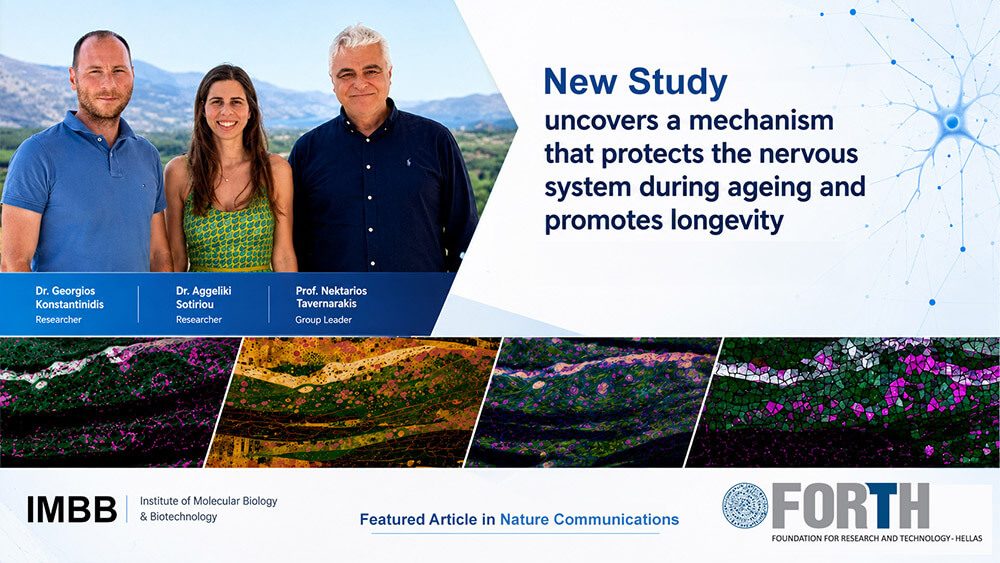
| A specialized enzyme that regulates the recycling of proteins, protects neurons and promotes healthy ageing |
Ageing is accompanied by a gradual decline in biological functions and an increased prevalence of neurodegenerative disorders. To maintain their functionality, nerve cells rely on intricate protein quality control and recycling mechanisms. At the center of these processes lies ubiquitination, the conjugation of ubiquitin molecules to proteins. This is a fundamental cellular process that regulates protein life cycle and cell function.
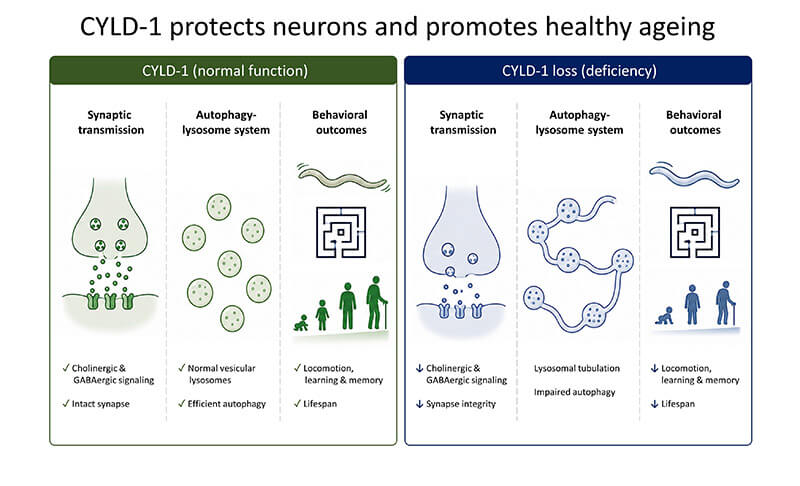
Using the nematode Caenorhabditis elegans as an experimental model, researchers at the IMBB-FORTH demonstrated that the CYLD-1 protein, which is closely related to the human CYLD protein, plays a key role in maintaining normal synaptic transmission, i.e., the communication between nerve cells. CYLD-1 acts as a deubiquitinase, removing ubiquitin molecules from proteins and ensuring the proper function of the neural circuits that control movement and behavior. Loss-of-function analyses revealed that disruption of CYLD-1 activity leads to progressive neurodegeneration, impaired neuromuscular communication, and a marked decline in locomotor performance. Furthermore, CYLD-1 is essential for higher-order cognitive functions, such as associative learning, underscoring its broad role in maintaining neuronal circuit integrity during ageing.
Of particular interest is the finding that CYLD-1 is a determinant of organismal lifespan. Its inactivation results in a significant reduction in life expectancy, whereas its activity appears to be in parallel to well-known longevity-associated pathways, such as insulin signaling, reproductive signaling, and caloric restriction. These results position CYLD-1 as a central node linking neuronal proteostasis with systemic ageing mechanisms.
Notably, the study uncovers a functional connection between CYLD-1 and the autophagy-lysosome system, a major cellular recycling and quality control pathway. This synergy supports neuronal homeostasis, thereby preserving cognitive and motor functions, and ultimately long-term organismal survival.
These findings reveal a new biological mechanism linking the maintenance of neural health to ageing and longevity. Understanding how deubiquitination and autophagy cooperate to maintain neuronal integrity may lead to new therapeutic strategies for neurodegenerative and other age-related diseases, with the ultimate goal of improving quality of life and promoting healthy ageing.
 |
This research was funded by:
- The CHAngeing project (GA-101087071) under the European Commission’s Horizon Europe Excellence Hubs program.
- The Neuromitophagy (HFRI‐FM17C3‐0869) and GliaAge (HFRI-16339) projects of the Hellenic Foundation for Research and Innovation.
For more information: Nektarios Tavernarakis
Professor, School of Medicine, University of Crete
Director of Research, Institute of Molecular Biology and Biotechnology, Foundation for Research and Technology (FORTH)
Email: tavernarakis@imbb.forth.gr | Tel.: +30 2810391069
Relevant links: https://www.nature.com/articles/s41467-026-73966-5 & https://tavernarakislab.gr/
Relevant video: https://youtu.be/EcGFlVL7Tjo