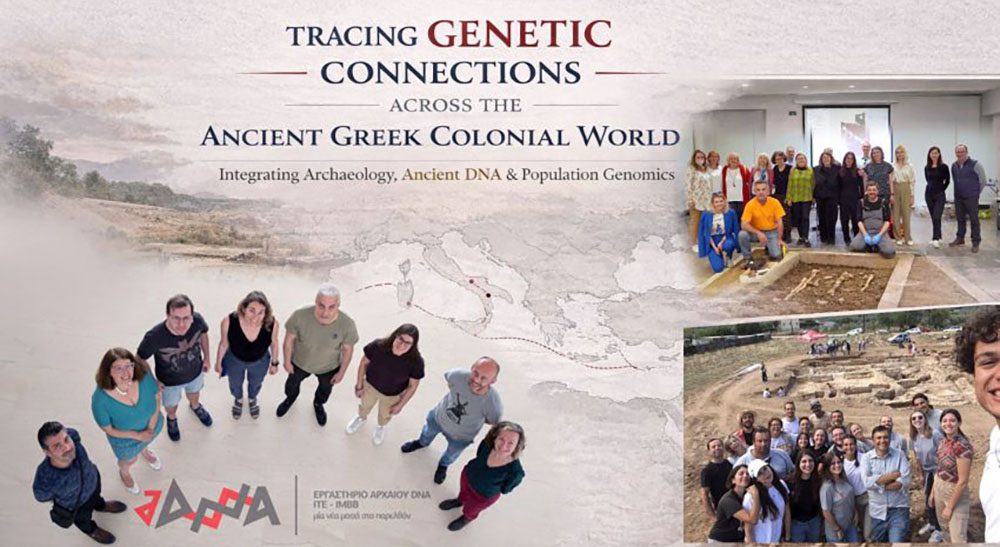
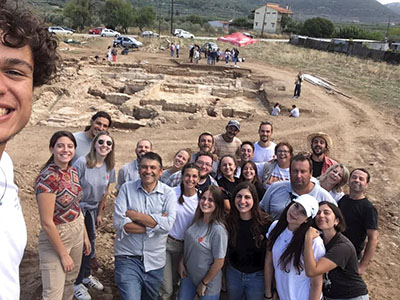
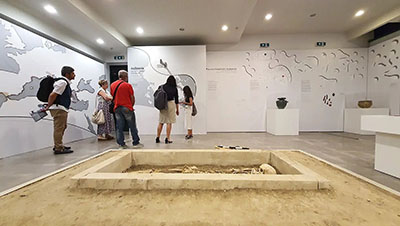
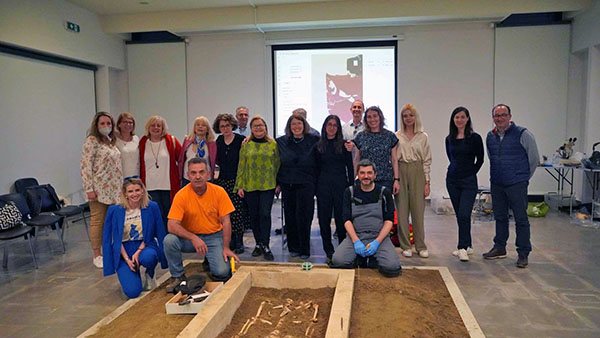
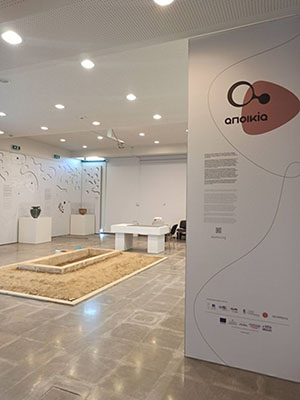
An interdisciplinary team of scientists from the Institute of Molecular Biology and Biotechnology (aDNA Lab IMBB) at the Foundation for Research and Technology – Hellas (FORTH), in collaboration with experts from multiple scientific fields, has shed new light on one of antiquity’s most captivating chapters: Ancient Greek colonization.
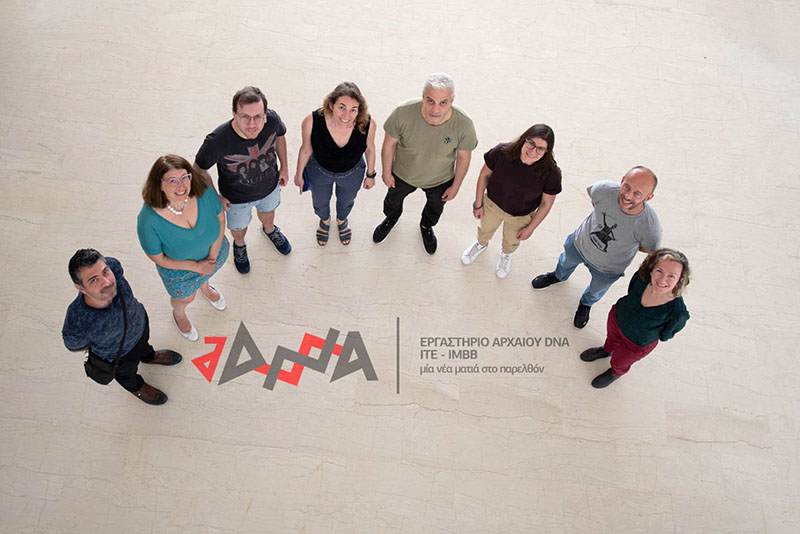
Their study on “Genetic affinities between the ancient Greek colony of Amvrakia and its metropolis”, published in the leading scientific journal Genome Biology, reveals how human mobility shaped the ancient Greek world beyond material culture.
During the early first millennium BCE, Corinth rose as a dominant maritime and commercial power, by establishing a wide network of colonies that connected southern Greece with Epirus and extended to as far as the eastern Adriatic coast. Among these settlements, Amvrakia—modern Arta in northwestern Greece—was founded in the second half of the 7th century BCE and quickly became one of Corinth’s most prominent colonies. Ancient sources describe Amvrakia as maintaining particularly close political, economic, and cultural ties with its metropolis. Yet while archaeology and history have long documented these connections, the biological relationships between the settlers and local populations remained largely unexplored.
Ancient Greek colonization was not a simple process of expansion, but one of negotiation, integration, and adaptation. To uncover its human dimension, the researchers turned to ancient DNA (aDNA) recovered from human remains and applied state-of-the-art population genomics methods to reconstruct the genetic history of Amvrakia across the centuries. Their goal was to understand how the colony foundation mechanisms worked, how local populations contributed to its formation, and how its people changed—or remained connected—over time.
The results reveal a highly interesting genetic landscape. During its foundation in the Archaic period, Amvrakia appears to have been shaped by genetic influences from a single source. This source migrated from the Corinthian territory, represented by the Archaic Tenea population. Interestingly, the local population represented by the Late Bronze Age (1350-1200 BCE) Ammotopos -excavation site-, located in close proximity to Amvrakia, was not inferred as a potential source. During the subsequent Classical (479-323 BCE) and Hellenistic (323-31 BCE) periods, the population of Amvrakia appears to have only slightly differentiated at the genetic level supporting the scenario of local genetic continuity over time.
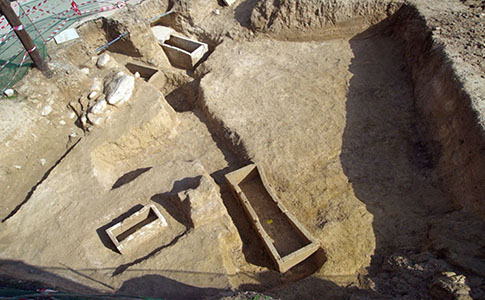
Strikingly, the strongest genetic ties between Amvrakia and Corinth appear during the colony’s foundation, when migration from the metropolis played a major role. Over time, however, the direct genetic influence of Corinth gradually diminished, despite the fact that a Corinthian genetic footprint remained present, well into the Hellenistic era. Excavations of Amvrakia’s cemeteries further enrich this story, uncovering intimate familial connections across neighboring graves, offering rare glimpses into the social bonds that linked individuals across space and generations.
Together, these findings transform our understanding of Greek colonization. Rather than being a simple territorial expansion by founding new colonies, the settlement of Amvrakia emerges as a shared human endeavor, shaped by both movement and continuity. Corinthian settlers not only imported their cultural traditions, but also their genes, to create a lasting community. This study reveals a shared voyage of genes and culture, illuminating the deeply human narrative that characterizes one of the ancient Mediterranean’s most powerful colonial networks.
The Project “APOIKIA” was Funded by the Operational Programme Competitiveness Entrepreneurship Innovation, ESPA 2014 - 2020, Co-financed by Greece and the European Union.
Link to the publication: https://link.springer.com/article/10.1186/s13059-026-03968-5
Innovation in Culture, Operational Programme Competitiveness Enterpreneurship Innovation, ESPA 2014 - 2020, Cofinanced By Greece and the European Union